From AI to IoT: IIMT University Showcases Cutting-Edge Research at India Mobile Congress 2026 in New Delhi
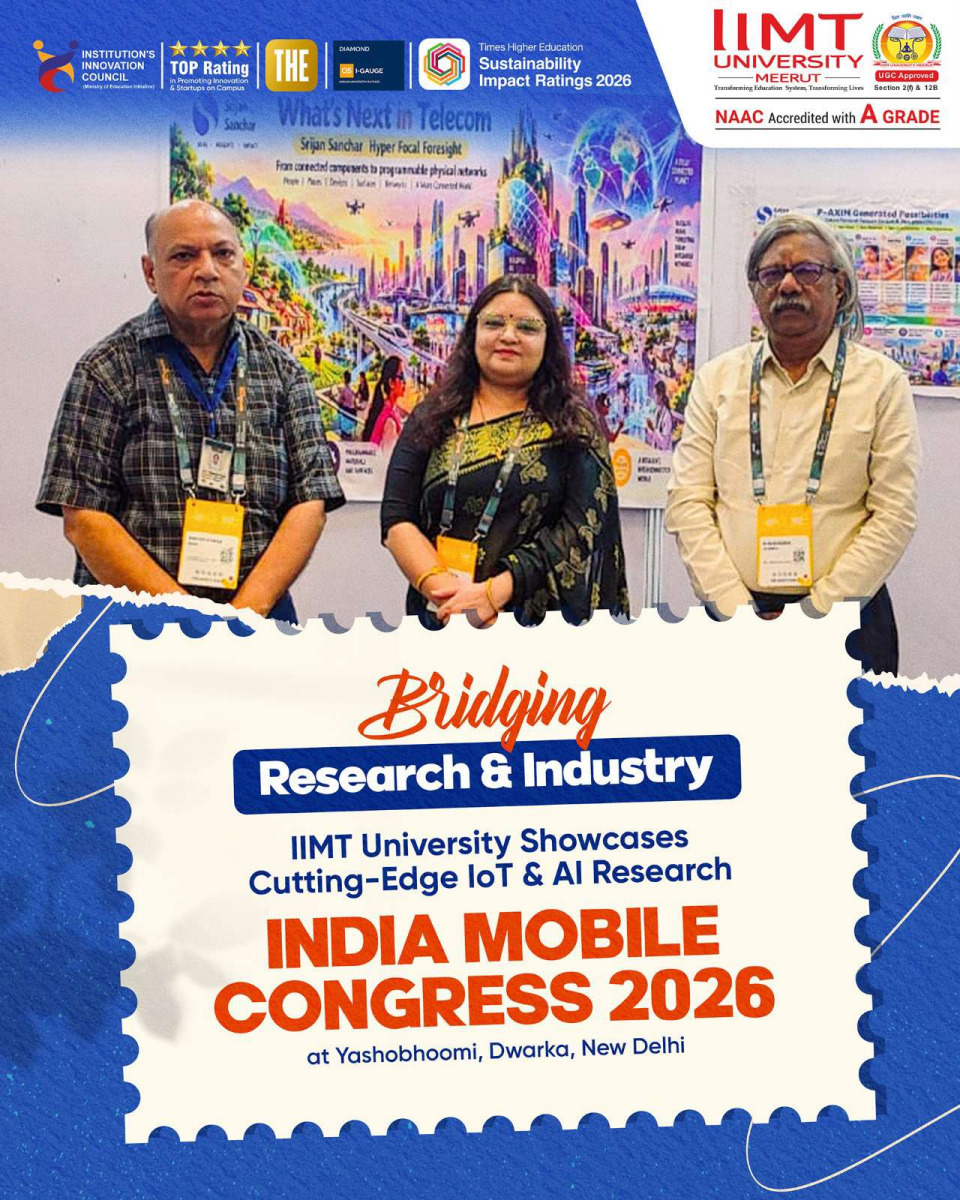
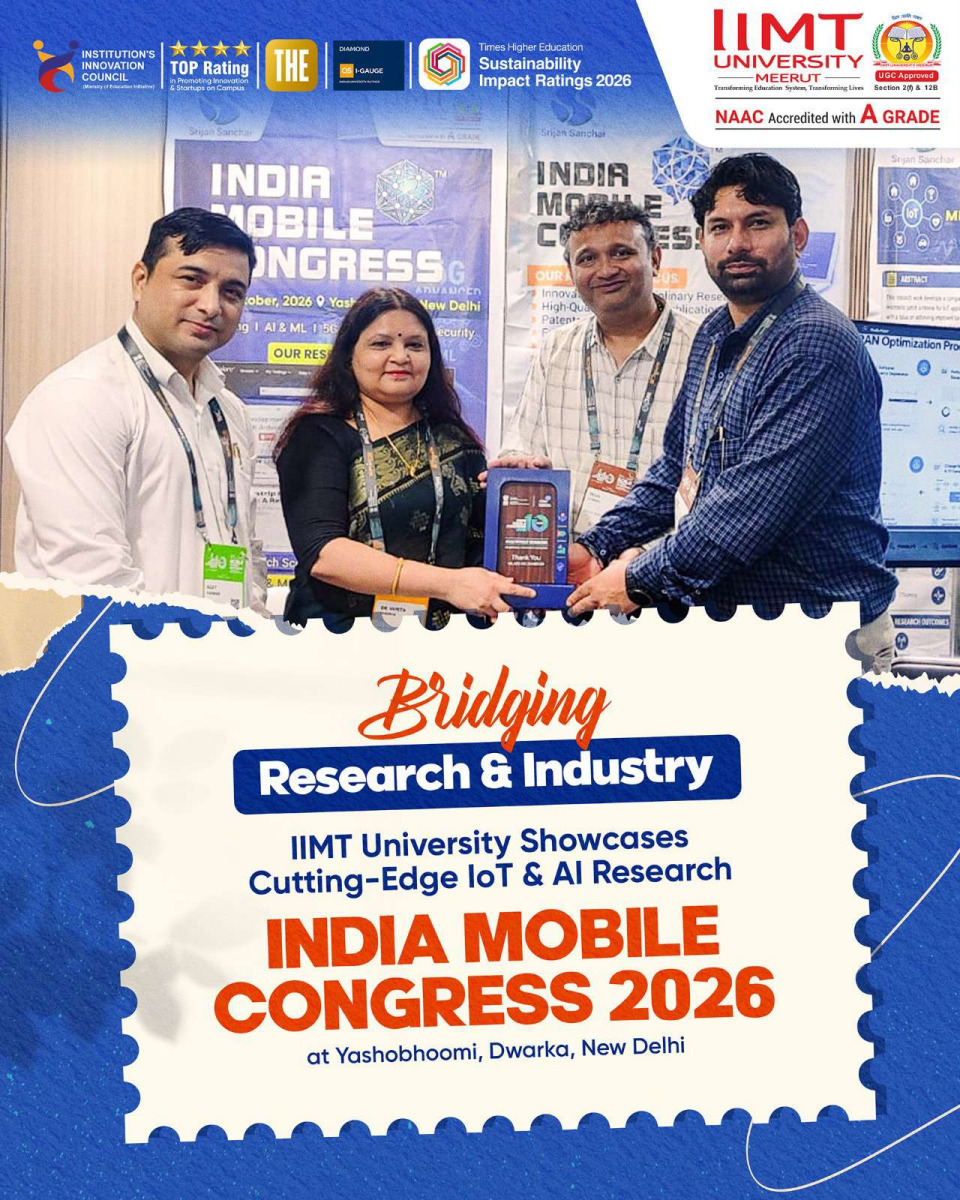
At a time when technology is transforming industries, education, healthcare, communication, manufacturing, and everyday life, IIMT University is strengthening the connection between academic excellence and industry-driven innovation. Through its engagement with the India Mobile Congress 2026 in New Delhi, the university highlights the growing importance of research, technological development, and practical learning in shaping India's digital future.
IIMT University Advances Innovation Through Artificial Intelligence and IoT Research
From Artificial Intelligence (AI) to the Internet of Things (IoT), emerging technologies are opening new possibilities for solving complex challenges and developing smarter, more efficient systems. By showcasing cutting-edge research and encouraging technology-driven thinking, IIMT University reflects its commitment to preparing students for a rapidly evolving digital economy.
Technology-focused platforms bring together researchers, technology professionals, innovators, industry representatives, and academic institutions. These interactions create opportunities to explore new ideas, understand emerging industry requirements, and identify ways to transform academic knowledge into practical applications.
For IIMT University, participation in technology-focused initiatives represents an important step towards promoting research-led education, strengthening industry engagement, and encouraging students to become active contributors to India's technological progress.
India Mobile Congress 2026: A Platform for Digital Innovation
The India Mobile Congress (IMC) is a major technology-focused platform associated with telecommunications, digital connectivity, emerging technologies, and innovation. It brings attention to developments shaping India's digital ecosystem and provides opportunities for dialogue among technology companies, researchers, policymakers, entrepreneurs, and educational institutions.
The 2026 edition in New Delhi offers a relevant setting for exploring technological advancements and understanding how innovation can address real-world challenges. Artificial intelligence, connected devices, intelligent networks, automation, cybersecurity, and next-generation digital infrastructure continue to influence technological development.
For universities, these platforms create valuable opportunities to connect academic research with practical industry requirements. Researchers can gain insights into emerging technologies, while students can develop a broader understanding of how classroom concepts translate into professional applications.
Artificial Intelligence: Transforming Research, Education, and Industry
Artificial Intelligence is one of the most influential technologies shaping the modern digital landscape. Its applications extend across healthcare, education, finance, agriculture, manufacturing, transportation, communication, and business operations.
AI systems can analyse large datasets, identify patterns, support decision-making, and automate selected tasks, creating opportunities for improved efficiency and innovation. At the academic level, artificial intelligence encourages interdisciplinary research and practical problem-solving.
Students and researchers can explore machine learning, natural language processing, computer vision, predictive analytics, and intelligent automation to understand how computational systems can address real-world requirements.
In healthcare, AI applications can assist with medical image analysis and clinical decision-support processes. In agriculture, data-driven models can help assess crop conditions. In manufacturing, intelligent systems can contribute to quality monitoring, predictive maintenance, and process optimisation.
At IIMT University, the broader focus on emerging technologies and research reflects the importance of preparing students to understand both the capabilities and limitations of artificial intelligence. Effective technological education must combine technical knowledge with analytical thinking, ethical awareness, data privacy, and responsible innovation.
Internet of Things (IoT): Building a Smarter and More Connected World
The Internet of Things (IoT) involves connecting physical devices, sensors, machines, and systems so they can collect, exchange, and process data through digital networks. IoT technologies are transforming how organisations monitor equipment, manage resources, track operations, and respond to changing conditions.
By combining connected devices with data analytics and automation, businesses and institutions can develop more responsive and efficient systems. Smart agriculture is one example of IoT's practical value. Sensors can measure soil moisture, temperature, and environmental conditions, helping farmers make better-informed irrigation and crop-management decisions.
In industrial environments, connected sensors can monitor machinery and provide information that supports maintenance planning. Smart buildings can use connected systems to manage lighting, energy consumption, and environmental controls.
IoT also plays a role in smart cities, where connected infrastructure can support traffic monitoring, waste management, environmental observation, and public-service planning. In healthcare, connected devices can collect selected patient measurements and support remote monitoring under appropriate clinical and privacy safeguards.
The integration of IoT with artificial intelligence creates further possibilities. Connected devices generate data, while AI systems can analyse that data to identify patterns, estimate future requirements, and support automated responses.
Connecting Academic Excellence with Industry-Driven Innovation
One of the most important aspects of modern higher education is the ability to connect theoretical knowledge with practical experience. As industries adopt advanced digital technologies, employers increasingly value graduates who can apply technical concepts, solve problems, communicate effectively, and adapt to new tools and working environments.
Industry-academia collaboration helps bridge the gap between classroom learning and real-world technological challenges. It can encourage research partnerships, expert interactions, practical demonstrations, internships, technical projects, and opportunities to understand emerging professional requirements.
For IIMT University, connecting academic learning with innovation-oriented platforms reinforces the value of developing industry-relevant knowledge and technical competencies. Students benefit when educational experiences encourage experimentation, critical thinking, teamwork, and the application of concepts to practical challenges.
Research and Development: Turning Ideas into Practical Possibilities
Research and development play a central role in technological advancement. New ideas become valuable when they are investigated systematically, tested against real requirements, refined through experimentation, and developed into solutions that address identifiable problems.
In areas such as artificial intelligence and IoT, research can involve designing algorithms, developing connected-device prototypes, evaluating sensor performance, analysing datasets, testing software applications, and investigating cybersecurity challenges.
Academic research also creates opportunities to explore the limitations of existing systems. AI applications must be assessed for accuracy, reliability, fairness, and transparency. IoT solutions require attention to connectivity, device security, interoperability, energy consumption, and data protection.
IIMT University's emphasis on cutting-edge research and innovation aligns with the broader role of higher education institutions in supporting technological advancement. By encouraging research-led learning, institutions can help students investigate problems, evaluate evidence, test possible solutions, and communicate their findings.
Preparing Students for Careers in Emerging Technologies
The growth of AI, IoT, automation, and digital infrastructure is creating evolving professional opportunities across technology and related industries. These developments increase the importance of technical education that combines foundational knowledge with practical experience and an understanding of current industry requirements.
Students interested in emerging technologies can benefit from developing competencies in programming, data analysis, machine learning, embedded systems, cloud computing, networking, cybersecurity, and software development.
However, technical knowledge alone is not sufficient. Successful technology professionals also need problem-solving abilities, communication skills, teamwork, project management, adaptability, and ethical judgment. These competencies help graduates work effectively across disciplines and respond to changing workplace expectations.
By promoting engagement with emerging technologies, IIMT University highlights the importance of preparing students for a future in which innovation and digital competence will remain significant across multiple sectors.
The Role of AI and IoT in India's Digital Transformation
India's digital transformation increasingly depends on the development and adoption of technologies that improve connectivity, strengthen digital services, and support innovation across economic sectors.
Artificial intelligence can help organisations interpret information and make data-informed decisions, while IoT can connect physical infrastructure with digital monitoring and control systems. Together, these technologies can support applications in healthcare, agriculture, logistics, manufacturing, education, energy management, and urban development.
Their effective adoption also requires attention to infrastructure, accessibility, affordability, cybersecurity, digital literacy, and responsible data governance. Technological progress becomes more meaningful when solutions are designed around practical needs and can be implemented reliably in diverse environments.
Universities contribute to this transformation by developing technical talent, conducting research, encouraging entrepreneurship, and creating opportunities for collaboration among students, academics, and industry professionals.
Responsible Innovation: Balancing Technology with Ethics and Security
As AI and IoT applications become more widespread, responsible innovation is essential. New technologies can create significant benefits, but their development and deployment must account for privacy, security, reliability, fairness, and accessibility.
Artificial intelligence systems may produce inaccurate or biased outputs if they are developed or used without appropriate evaluation. Organisations must consider the quality of training data, the suitability of algorithms, the explainability of decisions, and the potential consequences of automated recommendations.
IoT systems introduce additional considerations because connected devices may collect sensitive information or operate as part of larger networks. Secure device configuration, software updates, access controls, encrypted communications, and responsible data-management practices can help reduce risks.
Academic institutions can help address these issues by integrating ethical reasoning and security awareness into technological learning and research. Students who understand both the opportunities and risks associated with emerging technologies are better prepared to develop responsible solutions.
Strengthening the Future of Industry-Academia Collaboration
The future of technological development will depend partly on the strength of collaboration between educational institutions, research communities, technology companies, and public-sector organisations. Each group brings different expertise and perspectives that can contribute to solving complex challenges.
Universities offer research capabilities, academic expertise, and opportunities to develop future talent. Industry partners contribute practical experience, knowledge of customer needs, and an understanding of operational challenges.
Such collaboration may take the form of joint research projects, technology demonstrations, internships, professional training, expert lectures, innovation challenges, and entrepreneurship initiatives. These activities can help students understand professional expectations while allowing organisations to engage with emerging ideas and research talent.
The India Mobile Congress 2026 provides a technology-focused context for recognising the value of such engagement. For IIMT University, participation in the broader innovation ecosystem represents a step towards strengthening the relationship between academic learning, technological research, and industry requirements.
IIMT University: Advancing a Culture of Innovation and Excellence
A strong academic environment encourages students to ask questions, explore unfamiliar concepts, test ideas, and learn from practical experience. In technology-focused disciplines, this approach is particularly important because tools, programming frameworks, industry requirements, and research priorities continue to evolve.
IIMT University's engagement with emerging technology themes such as artificial intelligence, the Internet of Things, and digital innovation reflects the growing importance of research-oriented education. By highlighting the relationship between academic knowledge and industry developments, the university underscores the value of preparing students for a technology-driven professional environment.
Innovation also requires a willingness to examine problems from different perspectives. Students and researchers must be able to combine theoretical understanding with experimentation, collaborate across disciplines, and evaluate the real-world implications of proposed solutions.
Through academic engagement, industry awareness, and a commitment to developing relevant skills, IIMT University supports the wider objective of making higher education an active contributor to technological progress.
The convergence of Artificial Intelligence, the Internet of Things, and emerging digital technologies is reshaping industries and creating new opportunities for research, innovation, and professional development. As India continues to advance its digital capabilities, the connection between academic institutions and the technology sector becomes increasingly important.
The India Mobile Congress 2026 in New Delhi provides a relevant platform for exploring these developments and recognising the role of innovation in addressing modern challenges. For IIMT University, its focus on cutting-edge research and industry-driven innovation highlights the importance of connecting academic excellence with practical technological applications.
By encouraging research-oriented learning, strengthening industry awareness, and promoting engagement with emerging technologies, the university reflects the evolving role of higher education in preparing future professionals.
From AI to IoT, IIMT University continues to highlight the importance of connecting knowledge, research, and innovation to help shape the future of technology and education.
17-Oct-2026
Back