IIMT University Students Visit Rashtrapati Bhavan in New Delhi to Explore India's Democratic Heritage and Constitutional Values
An Educational Visit to Rashtrapati Bhavan: Connecting Academic Learning with India's Democratic Institutions
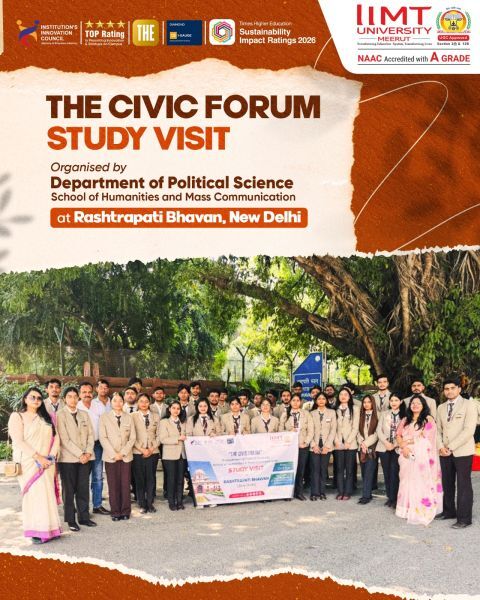
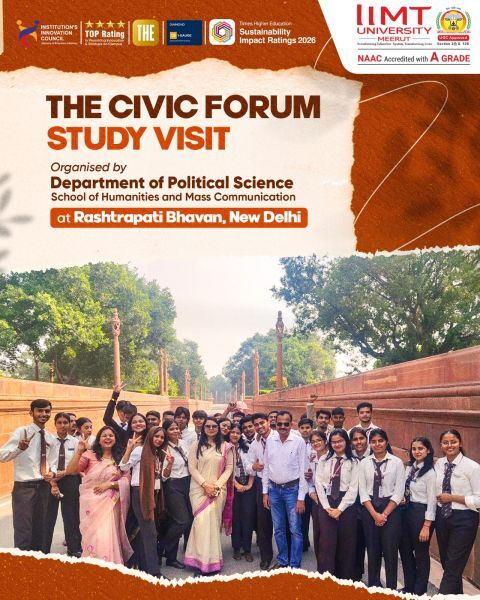
At IIMT University, Meerut, we believe that meaningful education extends far beyond classroom lectures, textbooks, and academic discussions. True learning takes place when students get opportunities to observe, explore, and experience important institutions that shape the nation's history, governance, and democratic framework. Keeping this educational philosophy at the forefront, students of the Department of Political Science, School of Humanities and Mass Communication, visited Rashtrapati Bhavan, New Delhi, on 23 October 2026, as part of an enriching educational initiative.
The educational visit was organised by The Civic Forum, providing students with an opportunity to explore one of India's most significant constitutional institutions. The visit aimed to strengthen their understanding of the Indian Constitution, democratic governance, the responsibilities of the President of India, and the historical importance of Rashtrapati Bhavan.
By experiencing the institutional environment firsthand, students could connect their theoretical knowledge of political science with the practical functioning and constitutional significance of India's highest constitutional office. The initiative also encouraged students to develop a deeper appreciation of India's democratic traditions, institutional responsibilities, and governance structures.
Rashtrapati Bhavan: A Symbol of India's Constitutional Democracy
Rashtrapati Bhavan, situated in New Delhi, holds an exceptional position in India's political, historical, and architectural landscape. It serves as the official residence of the President of India and represents the dignity, continuity, and constitutional authority of the Indian Republic.
Originally constructed during the British colonial period as the Viceroy's House, the building became the official residence of the President following India's independence and the establishment of the Republic on 26 January 1950. Today, Rashtrapati Bhavan stands as an important symbol of India's democratic transformation and constitutional identity.
For students of political science, visiting Rashtrapati Bhavan offers an opportunity to understand the historical transition from colonial administration to a sovereign democratic republic. It provides a meaningful context for studying the evolution of Indian governance, the development of constitutional institutions, and the responsibilities associated with the office of the President.
During the educational visit, students explored the heritage and significance associated with this prestigious institution, gaining a broader perspective on India's constitutional journey and democratic framework.
Understanding the Role of the President of India
One of the important academic dimensions of the visit was understanding the constitutional position and responsibilities of the President of India.
Under the Indian Constitution, the President is the constitutional head of the Union. The office represents the constitutional framework through which the executive, legislative, and other institutional functions of the country operate.
For students studying political science, understanding the President's role is essential to developing comprehensive knowledge of Indian parliamentary democracy. Classroom discussions often introduce students to constitutional provisions, presidential powers, executive responsibilities, and the relationship between different organs of government.
However, observing the institutional environment associated with the President's office offers another dimension to this understanding.
The visit encouraged students to reflect on several important aspects of Indian governance, including:
- The constitutional position of the President of India.
- The importance of constitutional institutions in a parliamentary democracy.
- The relationship between the President, the Prime Minister, and the Council of Ministers.
- The significance of constitutional procedures and democratic traditions.
- The role of institutions in maintaining continuity and stability in governance.
- The importance of constitutional values, public accountability, and responsible citizenship.
Such exposure helps students develop a more practical understanding of political institutions and their relevance to India's democratic system.
The Civic Forum: Promoting Constitutional Awareness and Experiential Learning
The educational visit was organised by The Civic Forum, Department of Political Science, School of Humanities and Mass Communication, IIMT University.
The Civic Forum provides an academic platform for encouraging discussions around citizenship, constitutional awareness, democratic participation, political institutions, and contemporary governance issues.
Through initiatives such as educational visits, interactive activities, and academic engagements, students are encouraged to move beyond conventional learning methods and explore the practical dimensions of political and constitutional studies.
The visit to Rashtrapati Bhavan reflected this commitment to experiential education. It provided students with an opportunity to engage with India's institutional heritage while strengthening their understanding of the values and principles that support democratic governance.
At IIMT University, we recognise that students pursuing political science must develop more than theoretical knowledge. They must also cultivate analytical thinking, constitutional awareness, civic responsibility, and an informed understanding of national institutions.
Educational initiatives organised through The Civic Forum contribute towards these academic objectives by creating opportunities for meaningful engagement with India's democratic framework.
Academic Guidance and Faculty Participation
The educational visit was conducted under the guidance and supervision of experienced university academicians and faculty members.
The initiative received guidance from:
- Prof. (Dr.) Neeraj Sharma – Dean
- Prof. (Dr.) Virendra Singh – Coordinator
- Dr. Ateeq-ur-Rehman – Head of Department (HOD)
The students were accompanied by faculty members Dr. Arshi Ansari, Ms. Pooja Jain, and Ms. Ritu Sharma, who supported and guided them throughout the educational initiative.
The involvement of the university's academic leadership and faculty members ensured that the visit remained connected to its broader educational objectives.
Faculty-led educational engagements play an important role in helping students interpret their experiences through an academic perspective. They encourage students to observe institutional practices, ask meaningful questions, connect their observations with classroom concepts, and develop a deeper understanding of the subjects they study.
At IIMT University, we value such collaborative academic initiatives because they create a learning environment in which students and faculty members participate together in knowledge-building experiences.
Experiential Learning: Taking Political Science Beyond the Classroom
Political science is a discipline that explores the foundations of political systems, constitutional governance, public administration, political institutions, citizenship, and the relationship between individuals and the state.
While classroom teaching provides students with the conceptual foundation of these subjects, experiential learning allows them to connect academic theories with real-world institutions.
The educational visit to Rashtrapati Bhavan demonstrated the importance of this approach.
Students studying constitutional law, Indian government, political theory, and public administration benefit from opportunities to understand how institutions acquire historical significance and contribute to the functioning of a democratic republic.
Such educational experiences can strengthen learning in several ways:
1. Developing Constitutional Awareness
Direct exposure to important national institutions encourages students to understand the importance of constitutional provisions, democratic principles, and institutional responsibilities.
2. Connecting Theory with Practice
Students can relate their academic understanding of the Indian Constitution and parliamentary democracy to the institutions through which constitutional governance is represented.
3. Strengthening Historical Understanding
Rashtrapati Bhavan's historical transformation provides an opportunity to explore India's journey from colonial administration to an independent constitutional republic.
4. Encouraging Critical Thinking
Educational visits inspire students to reflect on institutional structures, governance mechanisms, constitutional responsibilities, and the importance of democratic accountability.
5. Promoting Responsible Citizenship
Understanding national institutions helps students appreciate the importance of informed participation, civic responsibility, and respect for constitutional values.
These learning outcomes contribute to the overall academic and personal development of students, preparing them to engage thoughtfully with the social, political, and constitutional dimensions of contemporary India.
29-Oct-2026
Back