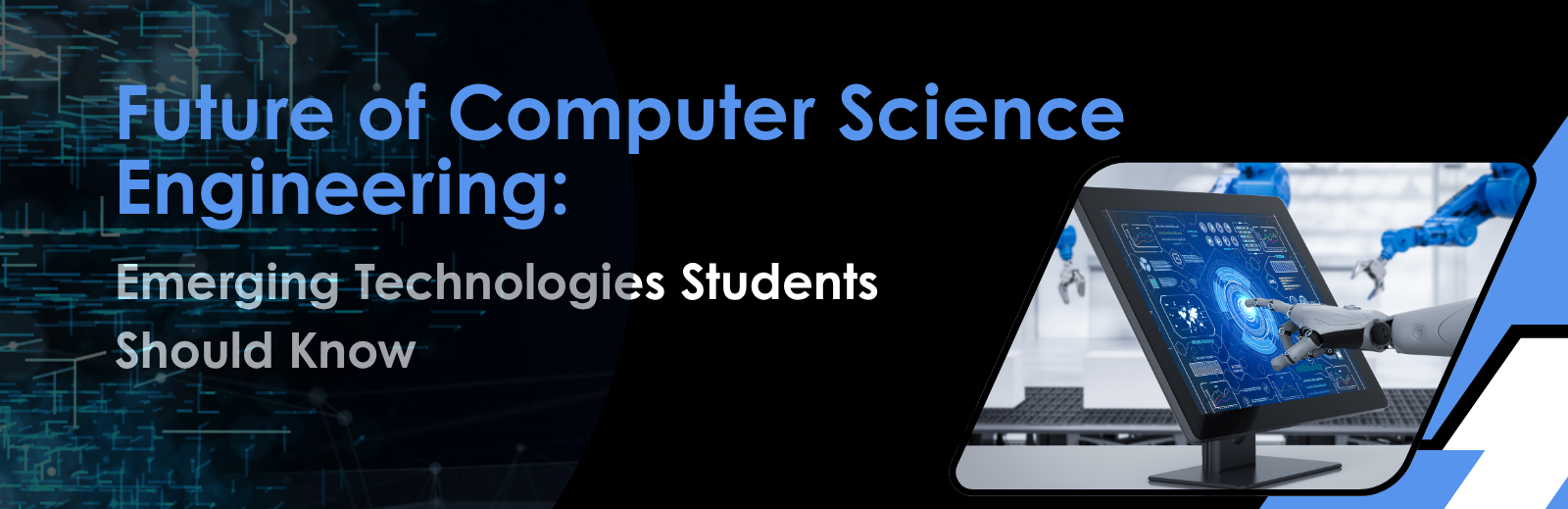
A B.Tech Computer Science Engineering degree has always promised broad career flexibility, but the specific technologies shaping that career are shifting faster than ever. The CSE curriculum that served graduates well five years ago is already outdated in several respects. For current and prospective students, understanding which emerging technologies will define the next decade of computer science careers is just as important as picking a well-ranked college.
Why the CSE Landscape Is Changing So Fast?
Three forces are driving this shift simultaneously: enterprise AI adoption is accelerating across every industry, not just tech companies; India’s digital infrastructure from UPI to smart cities is creating massive demand for engineers who understand large-scale systems; and global cybersecurity threats are pushing security awareness from a specialization into a baseline expectation for nearly every software role. Together, these forces mean b tech cse graduates today need a technology toolkit that looks meaningfully different from a decade ago.
Emerging Technologies Every CSE Student Should Understand
1. Artificial Intelligence and Machine Learning
AI has moved from a specialized elective to a foundational skill. Understanding how models are trained, deployed, and integrated into real products not just the underlying math is increasingly expected even in roles that aren’t explicitly “AI jobs.”
2. Quantum Computing
Still early-stage in practical application, but quantum computing research is accelerating globally, and India has made it a national research priority. Students with even foundational quantum computing literacy will have a head start as the field matures over the next decade.
3. Blockchain and Distributed Ledger Technology
Beyond cryptocurrency hype, blockchain’s underlying principles decentralized trust, smart contracts, and distributed systems are finding genuine enterprise applications in supply chain, finance, and identity verification.
4. Cybersecurity and Ethical Hacking
As digital infrastructure expands, so does the attack surface. Cybersecurity is no longer a niche specialization secure coding practices and threat awareness are becoming core expectations across almost all software engineering roles.
5. Cloud and Edge Computing
Modern applications increasingly split processing between centralized cloud infrastructure and edge devices for speed and efficiency. Understanding both paradigms not just one is becoming essential for building scalable, responsive systems.
6. Internet of Things (IoT)
From smart manufacturing to connected healthcare devices, IoT continues to expand rapidly. CSE graduates who understand how to design and secure IoT systems are well-positioned across manufacturing, healthcare, and smart infrastructure sectors.
7. Augmented and Virtual Reality
As AR/VR hardware matures and use cases expand beyond gaming into training, retail, and healthcare visualization, engineers who understand spatial computing and immersive interface design are entering a genuinely underserved talent pool.
8. Robotics and Automation
Industrial automation, warehouse robotics, and autonomous systems are expanding across manufacturing and logistics, creating strong demand for CSE graduates who can bridge software and hardware systems.
9. Bioinformatics and Computational Biology
As biology becomes increasingly data-driven, computer scientists with domain knowledge in genomics or healthcare data are finding unique opportunities at the intersection of tech and life sciences.
10. Green and Sustainable Computing
With data centers consuming enormous energy, engineers who understand energy-efficient system design and sustainable computing practices are becoming increasingly valuable as companies face growing pressure to reduce their environmental footprint.
What This Means for Choosing a CSE Program?
Given how quickly this landscape shifts, evaluating top universities in India for engineering requires looking well beyond a static course catalog. Key things to check:
- Curriculum update frequency — does the syllabus reflect 2026’s technology landscape, or is it running on a decade-old framework?
- Lab infrastructure — dedicated AI, cybersecurity, or IoT labs signal real investment, not just marketing claims
- Faculty exposure to industry — professors actively engaged with current research or industry projects tend to teach more relevant, up-to-date content
- Industry certifications and partnerships — collaborations with major tech providers add credibility and practical value beyond the core degree
How IIMT University Is Preparing CSE Students for This Future
IIMT University has structured its BTech Computer Science Engineering program around several of these emerging technology areas directly. The university offers a Google Cloud collaboration across select CSE programs, giving students structured, credentialed cloud computing exposure as part of the core curriculum. Dedicated AI and Machine Learning labs support hands-on project work in areas like AI, ML, and Data Science, while the broader curriculum incorporates cybersecurity fundamentals, IoT concepts, and modern software engineering practices.
Backed by NAAC ‘A’ accreditation and recognized through multiple 2026 rankings including a global #4 position in the WURI 2026 innovation rankings, IIMT University continues to position itself among the best computer science engineering colleges in India for students who want both strong fundamentals and genuine exposure to where the field is heading. Its placement cell (CRIC), connected with 2,500+ recruiters, also ties this technical training directly to real industry hiring expectations.
Final Thoughts
The future of b tech CSE isn’t a single trend, it’s a convergence of AI, cybersecurity, cloud computing, and increasingly specialized fields like bioinformatics and quantum computing, all reshaping what “computer science” actually means as a career. Students choosing a program in 2026 should prioritize institutions that treat these emerging technologies as core curriculum rather than optional add-ons, since the gap between a static CSE degree and a genuinely future-ready one will only widen as these technologies mature.