
Every December, thousands of law aspirants sit down for a two-hour paper that shapes the next five years of their lives. For CLAT 2027, that moment is almost here. According to the Consortium of National Law Universities, the CLAT exam 2027 is scheduled for Sunday, 6 December 2026, from 2:00 to 4:00 pm, in offline pen-and-paper (OMR) mode. With roughly a month to go, the question isn’t whether to prepare, it’s how to prepare smartly.
CLAT 2027 at a Glance
- Conducting body: Consortium of National Law Universities (NLUs)
- Mode: Offline (OMR-based)
- Questions: 120 multiple-choice questions, 1 mark each
- Duration: 2 hours
- Negative marking: 0.25 marks per wrong answer
- Syllabus and pattern: The Consortium has confirmed no changes for this cycle
Registration was scheduled to run from 3 August to 31 October 2026, so if you haven’t applied, check consortiumofnlus.ac.in immediately for any extension or update. Always treat the official site as the final word on dates and fees.
Important Subjects: Where the Marks Come From
The UG paper is divided into five sections, each testing a different skill:
1. English Language (about 20%). Passage-based questions test comprehension, inference, and vocabulary in context. Reading speed matters as much as grammar.
2. Current Affairs including General Knowledge (about 25%). Passages based on news and events from roughly the past year. Consistent newspaper reading beats last-minute cramming.
3. Legal Reasoning (about 25%). You’re given legal principles in a passage and asked to apply them to fact situations. You don’t need prior law knowledge — you need to apply the rule given, not your own opinion.
4. Logical Reasoning (about 20%). Arguments, assumptions, inferences, and analogies. This section rewards practice with critical thinking more than memorization.
5. Quantitative Techniques (about 10%). Class 10-level maths, usually presented through data interpretation sets. It’s the smallest section, but a reliable scoring one for students who stay calm with numbers.
Because every section is passage-driven, reading stamina is the single most important skill across the paper.
A Practical 30-Day Strategy
Week 1 – Diagnose. Take one full mock under timed conditions, then analyze every mistake. Note which sections cost you the most time and marks.
Week 2 – Fix weak sections. Spend extra hours on your two weakest areas, but keep daily touchpoints with all five sections so nothing goes rusty.
Week 3 – Mock-heavy. Aim for a full-length mock every second day, and spend more time reviewing than attempting. A mock without analysis is wasted practice.
Week 4 – Consolidate. Revise current affairs notes, re-read your error log, and shift to lighter, confidence-building practice. Prioritize sleep over one more late-night paper.
A few habits worth building right now:
- Read two editorials daily to train for long passages
- Attempt in order of strength — secure easy marks first, then tackle harder sets
- Guess strategically only when you can eliminate options, given the 0.25 penalty
- Maintain a current affairs notebook covering the last 12 months
Career Scope After CLAT and Law
Law remains one of India’s most versatile professional degrees. Graduates move into:
- Litigation — practicing in trial courts, High Courts, and the Supreme Court
- Corporate law — advising on contracts, mergers, compliance, and IP at firms and in-house teams
- Judiciary and civil services — judicial service exams, prosecutorial roles, and government legal positions
- Emerging fields — cyber law, data privacy, technology law, and arbitration, all expanding alongside India’s digital economy
- Policy, academia, and legal tech — research, think tanks, and legal technology startups
Beyond the NLUs: Widening Your Options
The top law universities in India include the NLUs, but they offer limited seats relative to the number of applicants. Smart aspirants plan a wider shortlist, and private universities in India have steadily built credible law programs with modern infrastructure, moot court training, and internship support. When evaluating LLB admission options, check Bar Council of India approval, faculty strength, moot court and internship access, and multi-year placement data.
Where IIMT University Fits In
For students who want a strong alternative or backup plan alongside CLAT, IIMT University, Meerut, is worth a serious look. The university offers a BA LLB program aligned with Bar Council of India norms, supported by moot court training, legal aid exposure, and internship opportunities through its Corporate Resource & Interface Centre (CRIC), which connects students with 2,500+ recruiters.
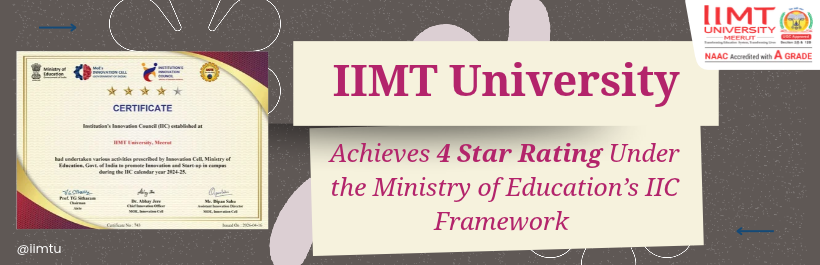
Backed by NAAC ‘A’ Grade accreditation and a strong run of 2026 recognitions including a 4-Star rating under the Ministry of Education’s Institution’s Innovation Council framework, a No. 1 position in Uttar Pradesh in the THE Sustainability Impact Rankings 2026, and a 4th-place global ranking in Entrepreneurial Culture and Ecosystem in WURI 2026, IIMT University is increasingly discussed as a top ranking university in India for students who value an innovation-driven campus. For prospective law students, that means access to a multidisciplinary environment where legal training sits alongside technology, management, and entrepreneurship.
Final Thoughts
CLAT 2027 rewards calm, consistent preparation far more than panic-driven marathons. Focus on reading daily, mock-test analysis, and steady revision across all five sections. And whatever your result, remember that a strong legal career is built on the quality of training, internships, and practical exposure you choose after the exam, so keep your options open, research widely, and pick the program that gives you the best foundation.