
Picture a farm in 2027: soil sensors reporting moisture levels to a phone, a drone mapping crop stress across acres, an AI model suggesting the best sowing window. That isn’t science fiction; it’s the direction Indian agriculture is moving. If you’re planning BSc agriculture admission, the degree you’re signing up for now sits at the meeting point of biology, data, and technology. Here are the ten technologies worth knowing before you step into the classroom.
10 Emerging Technologies in Agriculture
1. Precision Agriculture. Using GPS, sensors, and data to apply water, fertilizer, and pesticides exactly where and when crops need them. It cuts input costs and waste while improving yields.
2. Agricultural Drones. Drones now handle crop monitoring, spraying, and field mapping, covering large areas far faster than manual methods.
3. IoT Sensors and Smart Irrigation. Connected sensors track soil moisture, temperature, and humidity, and trigger irrigation automatically, a major step for water-stressed regions.
4. Artificial Intelligence and Machine Learning. AI models analyze satellite, weather, and field data to predict pests, diseases, and yields, helping farmers make decisions earlier.
5. Remote Sensing and GIS. Satellite imagery and geographic information systems help map land use, monitor crop health, and plan resources across regions.
6. Protected Cultivation, Hydroponics and Vertical Farming. Polyhouses, soil-less farming, and stacked indoor systems allow high-value crops to be grown with less land and water.
7. Agricultural Biotechnology and Genome Editing. From tissue culture to marker-assisted breeding and gene editing, biotechnology develops crops that resist pests, tolerate stress, and deliver better nutrition.
8. Agri-Robotics and Automation. Robotic tools for planting, weeding, harvesting, and sorting address labor shortages and improve consistency.
9. Blockchain and Digital Traceability. Tracking produce from farm to consumer builds trust, supports quality certification, and helps exporters prove origin.
10. Climate-Smart and Sustainable Technologies. Solar-powered irrigation, biofertilizers, bio-pesticides, and soil-health tools help farms adapt to climate pressure while reducing environmental impact.
Students who understand even the basics of these tools will stand out, whether they plan to work in agribusiness, research, extension services, or their own farms.
BSc Agriculture Course Details
Here are the BSc agriculture course details most applicants want to know:
- Duration: 4 years (8 semesters) for the B.Sc. (Hons.) Agriculture degree
- Eligibility: 10+2, typically with Physics, Chemistry, and Biology or Mathematics; minimum marks vary by university
- Core subjects: agronomy, soil science, horticulture, plant pathology, entomology, genetics and plant breeding, agricultural economics, and agricultural engineering
- Practical learning: laboratory work, field practicals, farm and industry exposure, and project work
- After the degree: M.Sc. Agriculture, MBA in Agri-Business, government and banking roles, agri-input and food companies, research, or your own enterprise
BSc Agriculture Admission: What to Expect
The usual BSc agriculture admission process involves checking eligibility, applying through the university’s portal, and qualifying through an entrance route such as CUET, ICAR’s national exam, or a state agriculture test, depending on the institution. Counseling, document verification, and fee payment follow. Requirements and deadlines differ by university, so confirm them on the official website before applying.
Choosing Among the Top Agriculture Universities in India
India’s best-known agricultural institutions include the ICAR-linked and state agricultural universities, but private universities have built credible programs too, including Lovely Professional University, GD Goenka University, Galgotias University, GLA University, Graphic Era Hill University, IFTM University, Integral University, and IIMT University. When comparing top agriculture universities in India, look at:
- Curriculum updates that include technology topics like those above
- Farm, lab, and field facilities for hands-on training
- Industry and research tie-ups for internships
- Pathways to higher study such as M.Sc. and MBA in the same campus
How IIMT University Prepares Agriculture Students
IIMT University, Meerut, launched its B.Sc. (Hons.) Agriculture program through the School of Agricultural Sciences in 2018. The curriculum follows an NEP-aligned structure and a semester system based on the ICAR Fifth Deans Committee report, covering core agricultural sciences alongside agricultural engineering, agro-meteorology, environmental science, basic sciences, and computer science, which is a useful foundation for the technologies listed above.
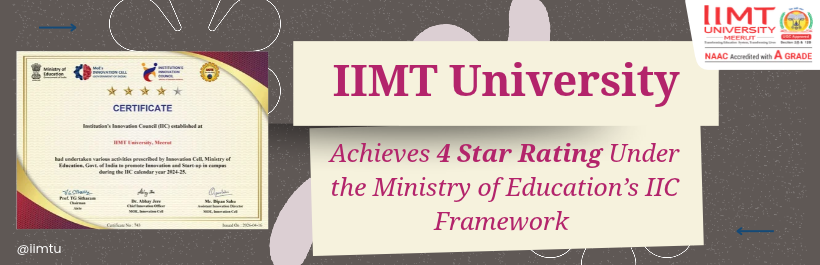
Students also benefit from the wider campus ecosystem. IIMT holds a 4-Star rating under the Ministry of Education’s Institution’s Innovation Council framework, and the IIMT Business Accelerator Foundation supports startups with focus areas that include agriculture, healthcare, AI, and IoT, so agri-tech ideas have mentors close by. Graduates can continue within the university through M.Sc. specializations such as Horticulture, Genetics and Plant Breeding, and Soil Science, or an MBA in Agri-Business Management.
With NAAC ‘A’ Grade accreditation and recognition in 2026 rankings including WURI and THE Sustainability Impact Rankings, IIMT University is increasingly discussed as a top ranking university in India among private institutions.
Final Thoughts
Agriculture is becoming one of the most technology-rich careers in India, and BSc Agriculture students who learn these tools early will have more choices after graduation. Choose a program that blends strong fundamentals with practical exposure and an innovation-friendly campus, and your degree can open doors from the lab to the field to the startup stage.